Blog
Charles Tiné: the French entrepreneur who built humanitarian projects in Ukraine
February 2022 — Russia invades Ukraine. From Paris, the war arrives on screens: missiles, evacuation trains, families fleeing west.
In an alternate version of this story, Charles Tiné watches the news, feels terrible, and moves on with his day.
But that’s not what happened, and that’s not the path this French entrepreneur chose.
In Paris, between projects, Charles watched the unfolding invasion and was struck by how close it felt — just a two-hour flight away. Too close to ignore.
“I thought that I could be more useful helping volunteers at the border than just staying in front of my television,” he says. “So I took a backpack, flew to Kraków, and then went to Przemyśl, where everything was happening at the border — and it was like the Exodus.”
What he found there was not a system, but improvisation on a massive scale. The crossing point was tiny — just one lane and two desks for border officers — yet tens of thousands of people were waiting on the Ukrainian side in freezing temperatures. Volunteers from across Europe had built makeshift corridors offering clothes, food, hygiene kits, toys, and SIM cards.
Tiné saw a French flag, walked over, and asked what he could do.
“The guy handed me a big spoon and a big pot of hot chocolate,” he recalls. “And he said, ‘You can serve the hot chocolate.’”
That was how it started.
At first, the work was simple and immediate: handing warm drinks to exhausted families. But within days, he was helping turn a Tesco shopping center in Przemyśl into a transit hub for refugees. Fifty to sixty volunteers, most with no humanitarian background, worked around the clock to support roughly 2,000 people a day as they tried to understand where to go next.
“Our job was to find them the best solutions,” he says.
He crossed into Ukraine to help elderly refugees carry their luggage from the border to buses waiting 300 meters away.
“We took shopping carts from supermarkets and pushed their belongings alongside them.”
Later, in Lviv, he helped set up an information center at the railway station so people could understand their options before deciding whether to leave the country. That work ended after the April 8, 2022, attack on Kramatorsk railway station.
A month and a half after arriving, Tiné returned to Canada, where he was living at the time.
He quickly realized he could not go back to his old way of life.
“When I got back to Canada, it was just absolutely impossible to stop,” he says. “I had put my fingers into something stronger than anything I’d lived through in my life.”
Together with volunteers he had met during those first chaotic weeks, he founded The Small Projects Team in April 2022.
The organization was built around a simple idea: small, focused projects can make an immediate and measurable difference.
Its philosophy is unusually direct.
“Our DNA is not to collect goods in France and send them to Ukraine,” Tiné explains. “We collect funds and try to spend all of the funds in Ukraine.”
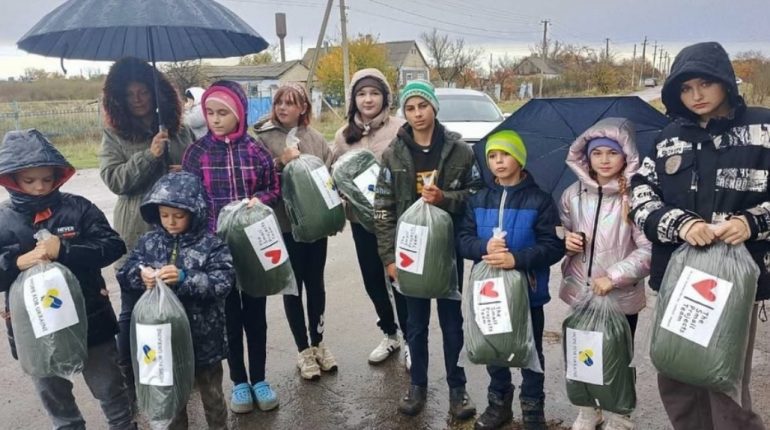
That means buying from Ukrainian manufacturers whenever possible — sleeping bags sewn in Kremenchuk, wood stoves made in Makariv and Kryvyi Rih, and books and games produced locally. In this model, humanitarian aid does more than meet urgent needs; it also supports the country’s economy.
The projects themselves are often modest in scale, but powerful in effect.
During the winter of 2025–2026, as Russian attacks threatened both electrical and gas infrastructure, the organization launched Winter Hugs, a campaign to distribute sleeping bags and power banks to families facing freezing temperatures and prolonged blackouts.
More than 3,100 sleeping bags have already been delivered.
“If I receive a donation now, all the money will go to sleeping bags and power banks,” Tiné says. “If you tell me you’re going to send money in April, it’s going to be a different story.”
.png)
What project are you most proud of?
We are basically proud of everything we’ve done because all of our programs have been impactful. But some are particularly meaningful.
“Tsikava Hatka” is one of them. These are small house-shaped shelves made locally by a furniture company. We send them to hospitals, shelters, community centers, and orphanages so children can still play and experience something close to a normal life.
When children spend three, four, or five hours in underground shelters during air raids, we try to give them something to do together — not just their phones, especially when there is no connection due to jamming. The books come from Staryi Lev, and the games are produced in Ukraine.
Power banks are also extremely important because when a city is attacked, people need to communicate and confirm that their relatives are safe.
The amputee football project — UAmpFoot — is also very important because it gives hope to the tens of thousands of people in Ukraine who have undergone amputations.

Tell us more about UAmpFoot.
It goes back to late 2023, when I was in Lviv. A friend from city hall said, “Come with me to meet my friend Bohdan.” We went to a place on the outskirts of Lviv, and I saw players with one leg and crutches running on the pitch and doing extraordinary things with the ball. I was absolutely impressed by the speed of the game.
By then, I had already started seeing more and more people in Ukrainian cities who had lost limbs — many around the age of my own son. I also met teams from Superhumans, Unbroken, and other rehabilitation centers in Lviv, and I began thinking about how to help develop this sport and create clubs.
So we launched UAmpFoot in 2024. The idea was to provide small grants to teams willing to start amputee football clubs. The first few thousand euros are crucial — at that stage, everything is missing.
We created a kick-start kit of about €5,000 per club: crutches, equipment, balls, pitch gear, a small budget for coaches and medical staff, and materials for rehabilitation centers.
So far, we’ve helped create five clubs: Odesa, Kryvyi Rih, Lutsk, Zhytomyr, and Dnipro. Dnipro won the Winter Cup last year, and Lutsk has qualified for the European Championship.
Some people ask: why spend €5,000 on 20 people when the same amount could fund hundreds of sleeping bags?
We don’t see it that way. We’re not helping only 20 people — we’re helping their families too. Children see a parent who has returned from the front line injured, sometimes struggling with depression, and they see them playing again, smiling again.
It’s 20 people multiplied by three or four family members. And then the impact spreads further, because matches are broadcast on MEGOGO and YouTube. People with amputations everywhere can see that recovery and participation are possible.
It’s not elite sport. It’s social impact.

How do you measure impact beyond numbers? What makes a collaboration successful?
Sometimes we come to Ukraine and have nothing material to bring. We cannot say yes to a project because we simply do not have the money. And what our partners always tell us is that the simple fact that we are still coming, that we are still there four years later, is incredibly important to them.
It’s always the same answer: “It’s not a problem. Just the fact that you are there, that you continue to be there — even if you don’t have anything to give us — simply coming to Ukraine and remaining active brings us a lot of hope at a time when many people in Ukraine feel that much of the world has forgotten about them.”

How do you find donors, and why do people choose you over larger organizations?
We have individuals who give €20 a month, as well as larger companies that support us annually. Some donors also fund specific programs when we reach out.
People trust us because of our efficiency and transparency. We report everything, share all invoices, and have no overhead costs — everyone is a volunteer.
Most importantly, the time between receiving money and spending it on the ground is very short. For example, funds received last week for sleeping bags and power banks were distributed in Kherson within about four days.
That speed matters to donors. Many want immediate impact and direct traceability of their contribution.
We also ran a major Winter Hugs program with the Canada Ukraine Foundation and the Ukrainian Canadian Congress. Everything — from funding approval to final distribution — was completed within a month.

Has your perspective changed since you started working in Ukraine?
I discovered a country I didn’t know, and I truly fell in love with it.
Everyone praises the resilience of the Ukrainian people, and I agree — they are extraordinary. But it has also restored my faith in humanity, because I believe resilience is part of being human. My question is: would we be any different in France if the same happened to us? I hope not.
I also left France because I was tired of constant complaining. In Ukraine, it is the opposite. I bring things, but I receive far more in return — energy, direction, and ideas.
Of course, the situation is extremely hard. Civil society is under immense pressure, and there is widespread trauma. But there is also a generation reshaping the country. It is absolutely incredible to see what women are doing. They have taken the lead in many fields because so many men are on the front line.
There is a part of me in Ukraine now.
After the war, one thing I want to do is take a van and embark on what I call my Ukraine Peace Tour — to meet all the people I have been in contact with over these four years but have not yet met in person.

What would you most like people to know about your work and the situation on the ground?
The war is not over.
Just because it has become less visible in the news does not mean the situation on the ground is improving. In many ways, it is getting worse.
Russia’s strategy is to target civilian infrastructure, especially heating and power systems, in order to make life unbearable in major cities.
I was in Kyiv recently and heard about a 90-year-old woman — a Holocaust survivor — who died because her apartment became too cold during blackouts.
In places like Kherson, civilians are still being targeted by FPV drones. People can be walking home from the supermarket and be killed in seconds.
Around 70 percent of Ukrainians are involved in some form of humanitarian action. It is a society working together under extreme pressure.
We are just one part of that chain. And when people donate — whether to us or to others — the aid reaches people quickly and directly because most of us are volunteers.
It is incredibly important to continue supporting Ukraine. The war is not over — far from it.
So spread the word. And if you can, support organizations like ours.

All photos: The Small Projects Team (thesmallprojects.org)
To support The Small Projects Team: thesmallprojects.org/en/make-a-donation
Gallery
No items found.