Blog
Maksym Butkevych on captivity, propaganda, and what freedom really means
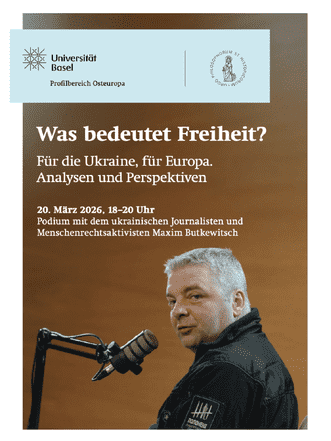
Notes from a panel discussion at the University of Basel, 20 March 2026
An evening with Maksym ButkevychUkraine – four years of war. What does freedom mean?
When the audience entered the hall, Maksym Butkevych was already seated on the panel. A calm, almost unremarkable man — with a quiet, heavy gaze. He speaks softly, without pathos. And precisely for that reason, every word lands.
Journalist, human rights defender, activist, soldier, prisoner of war — and since October 2024 a free man.
From anti-militarist to soldier
Butkevych has dedicated his life to resisting violence — as a journalist, as an activist of the 2013 Maidan Revolution, and as a human rights defender. When Russia invaded in February 2022, he volunteered for the army. No contradiction, he says: "One does not need to feel guilty for violence when one is defending oneself."
Captivity and the silence of families
In June 2022, he was taken prisoner by Russian forces. A show trial sentenced him to 13 years in a penal colony. In October 2024, he was released through a prisoner exchange — thanks to international pressure, including significant involvement from the European Civic Forum.
He spoke openly and concretely about his captivity. Prisoners were systematically broken psychologically: forced to sing the Russian national anthem, repeat atrocities, and give statements aligned with propaganda. Those who refused were physically tortured. Some, he said quietly, even to death.
He also spoke about the others: civilian detainees — people who disappear without charges, without trials, without any contact with their families. It is estimated that between 2,000 and 16,000 civilians are currently held in Russian captivity. Their families remain silent out of fear of being targeted themselves. Little is heard about this — and that is intentional.
Propaganda — precise, adaptable, dangerous
Butkevych analysed Russian propaganda strategy with unsettling clarity. Internally, within Russia, it legitimises the war and frames it as a defensive struggle against the West. Externally, here in the West, it adapts to its audience: conservatives receive arguments against the EU and liberal values; left-leaning audiences receive arguments against Americanism and globalisation. The message remains the same — only the language changes.
"Truth is not relative," he said. "Truth is not what is said. It is what exists." And Russia has invaded Ukraine. The hall applauded.
He also acknowledged that even Ukrainians are not immune to propaganda — a painful and honest observation. As elsewhere, conspiracy theories have entered Ukrainian society. This makes the work of activists even more urgent.
Freedom — lived, not only conceptual
He spoke about freedom not as a political concept, but as a physical, existential experience. Those who have truly been imprisoned — without escape, without voice, without dignity — know what the word means. "Without freedom there is no justice," he said. "Without justice, the state decides — not the people."
Human rights, he reminded, are one of the youngest achievements of history — barely three generations old, fragile, never guaranteed. "If we forget these values, the whole world will become like Russia." Not a threat. Just a quiet, unwavering conviction.
Where does strength come from?
From the audience came the question: How do you manage? How do you remain strong? His answer was free of any heroism: "People are afraid. Of course they are afraid. No one is made to fight." But Ukraine had no choice — during Maidan, in 2014, in 2022. Each time everything was at stake. Each time they chose to resist. And each time, this experience deepened solidarity.
Regarding growing apathy in Europe, he was clear: "Ukraine is not defending Ukrainian values. It is defending universal values — your values. And the moment is now." Again, applause.
The West — gratitude and open questions
Butkevych expressed sincere gratitude toward the West — without Western support, Ukraine would not have survived four years. But he was also direct: support in 2022 came too late and was too limited. The recent shift in US policy leaves him and many others disoriented.
"We do not understand why. We ask ourselves which side they are on." Hundreds of millions of people in Eastern Europe who trusted NATO now feel abandoned — between the West and Russia, unsure whether anyone still sees them.
A witness who keeps speaking
Maksym Butkevych travels the world speaking. Together with other Ukrainian activists, he seeks to influence public opinion, decision-makers, and all of us. This evening understood that.
The motto of his radio station remains:
"Listen — think!"
Gallery
.png)
.png)
.png)
.png)
No items found.