Blog
Bread in Ukrainian Culture and Rituals
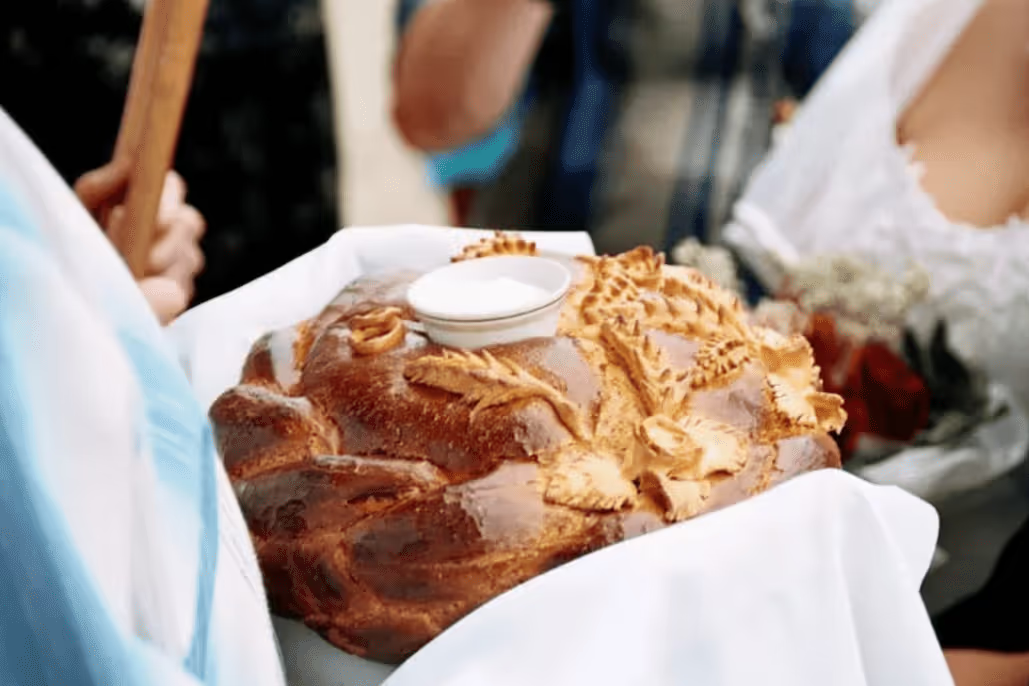
Songs are composed about it, it was used as an ancient monetary unit and as a central element of rituals in several world religions, and its shortage has provoked riots and revolutions. We are speaking, of course, about bread — a product so important to the human diet that even its name is used as a synonym for food in general.
What role does it play in Ukrainian culture?
Bread and various flour products have occupied an important place in the family and calendar customs and rituals of Ukrainians, as they were associated with the well-being and happiness of every family. No other traditional dish can compare to bread in terms of its preparation methods and the variety of finished baked goods.
.avif)
Bread in the Ukrainian Worldview
For Ukrainians, bread is not merely a material thing — it is a sacred object, an object of worship, a talisman, a sacrificial food, or even a deity itself or an embodiment of divine power. It is kissed, oaths are sworn upon it, agreements are sealed with it, and well-being and even life itself are associated with it, since the words "zhyty" (to live) and "zhyto" (rye) in the Ukrainian language share the same root.
Some researchers explain Ukrainians' careful attitude toward bread and bread crumbs by the famines they have experienced. However, detailed ethnographic studies show that we are so thrifty not because of poverty and hunger, but thanks to the ancient high culture and traditional beliefs of Ukrainians.
Bread is identified with the life-giving sun. Customs and rituals associated with bread are alive today and can be traced through many centuries.
Ukrainians still call bread "holy," "God's gift," "father," "provider," "head," and "master."
.avif)
Folk Wisdom About Bread
Folk wisdom says: "Think for a hundred years, and you won't come up with anything better than bread." Bread is the head of everything! Bread is what every day begins with, the life of a person, the life of our country, the life of the entire planet.
Our people have composed many sayings and proverbs about it: "Bread on the table — God in the house," "It is not we who carry bread, but bread that carries us," "Rye bread is like a dear father," "Bread is the father, water is the mother, with bread even the table is a throne, and the house is wealthy," "With bread, songs are sweeter and the house is warmer," "Whatever you eat, you still want bread," "Where there's bread aplenty, even under a willow is paradise," "Without a piece of bread, even fish is disgusting," "A hungry godmother thinks only of bread," "Foolish as bacon without bread," "A pear is fleeting, but bread is for every day," "Without salt it's not tasty, but without bread it's not filling," "Whose bread you eat, that person's song you sing," "If there's bread on the wagon, there's no trouble on the road," "There's no bread without work, and no work without bread."
.avif)
Bread in Family Rituals
No important event in Ukraine takes place without bread.
People go matchmaking with bread, bread is returned to break off a marriage agreement, bread is used to bless couples for married life, bread accompanies housewarming celebrations, and bread is present at funerals. "In general, the custom of arriving with bread and not returning empty-handed, that is, symbolically gifted. Even where kalachi were not baked, they gave two pirozhky..." writes L. F. Artiukh about the use of bread.
Guests are greeted with bread and salt on an embroidered towel. Today, this ritual symbolizes special hospitality, although in ancient times it had a protective meaning: "Bread and salt were used to meet strangers on the road — so that evil from them would not be the first to enter the house."
Types of Ritual Bread
Ukrainians take pride in the enormous variety of bread products. The main types include: korovai (wedding bread), dyven, kalach (ring-shaped bread), lezhen, kryzh, perepiyets, shyshky (decorative bread "cones"), yaryl bread, knysh, korzh (flatbread), kolobok, perepichka, kalyta, varenyky (dumplings), pampushky (garlic buns), halushky (dumplings), and more.
Kalach (Ring Bread)
Kalach is bread made from wheat flour. It symbolizes prosperity and well-being. In ancient times, kalachi were baked for the festivals of the spring and autumn equinoxes, winter and summer solstices. They were used to honor distinguished people, at harvest festivals, holy Koliada celebrations, wedding ceremonies, and on Kupala nights. They are baked for Easter, the birth of children, for Bread Savior Day, and Christmas.
Works by Ukrainian scholars devoted mainly to rituals and folk nutrition contain numerous facts about the use of kalach by Ukrainians in the ritual practices of calendar holidays: on Holy Evening before Christmas, kalach is placed on the table; kalach covers the pot with kutia, where it lies throughout the holidays until New Year; it is consumed by family members and given to livestock; kalach is part of the "dinner" that children carry to the midwife, godparents, and relatives during Christmas holidays; kalach is blessed at Easter. Kalach is used when inviting guests to a wedding; the bride looked through the hole in the kalach at the groom after the wedding ceremony; kalach is given as gifts to bridesmaids, groomsmen, etc.; kalach is divided among relatives and guests; the married couple keeps the bride's kalach, with which she went to gather periwinkle for her wreath and invited her family to the wedding.
.avif)
Lezhen
Lezhen is a ritual bread, but much larger than a regular kalach. It was prepared similarly and used to honor newlyweds, matchmakers, and wedding guests. These breads, as protective talismans, lay on festive tables throughout the Koliada holiday (Christmas). People prayed to them and honored the labor of farmers with them.
.avif)
Kalyta
Kalyta is a large round flatbread with a hole in the middle. It was baked from wheat flour, beautifully decorated, glazed with honey, and sprinkled with poppy seeds. It symbolized the sun and stars.
.avif)
Korovai
There are several types of korovai, each serving a distinct ceremonial purpose. Easter korovai are special breads dedicated to the heavenly luminaries—the Sun, Dazhboh, and Yarylo—and are traditionally used alongside krashanky and pysanky (decorated Easter eggs). These items, according to ancestral beliefs, symbolize the renewal of the Universe. Making korovai requires great skill; it is considered both an art and a form of deep ethno-philosophy, or phyto-ethnology.
Korovai are also baked for weddings, where they hold a central ceremonial role: blessing the couple and symbolizing prosperity, unity, and fertility. Wedding korovai are decorated with wheat ears, stars, willow (the primordial tree of life), and doves, honoring celestial bodies, the newlyweds, and distinguished individuals, celebrating their deeds and greatness.
Among all ritual breads, the wedding korovai is the most magnificent and elaborate. As F. Vovk wrote, “Korovai is a sacred bread with great ritual significance, undoubtedly once serving as a sacrificial offering”Baking a korovai is a profound ritual, accompanied by numerous ceremonial actions, beliefs, and songs. The success of the korovai was thought to predict the couple’s future: a beautiful korovai promised a happy life, while a cracked, misshapen, or burnt bread was seen as an omen of misfortune in marriage.
.avif)
Paska (Easter Bread)
For Easter, ritual bread called paska was baked from rich dough, decorated with colored millet, poppy seeds, and powdered sugar. The tall and fluffy Easter bread was meant to ensure a better harvest, greater livestock breeding, fertility, and fruitfulness. The fate of family members, their health, and life were determined by it.
Traditions of Honoring Bread
Reverence for bread has long been established in Ukrainian customs. In the place of honor under the icons, which is the sacred place in the house, a loaf covered with an vyshytyi rushnyk (embroidered towel) always used to lie on the table. Every piece of bread was eaten completely, leaving no scraps, so as not to lose its strength. Crumbs were gathered in the palm and eaten, or given to livestock or birds. Bread that was not eaten in the field was brought home and given to children as a treat "from the bunny." If a piece of bread accidentally falls on the floor, villagers pick it up and kiss it — apologizing to it.
.avif)
Divination by Bread
Based on how the bread turned out, people predicted what the next week would be like; based on how the ritual breads (pies, kalachi, paska...) turned out for calendar holidays, they predicted whether the period until the next holiday or the entire year would be successful; and based on how the wedding korovai turned out, they predicted whether the entire married life would be successful. "Bread was baked once a week — on Saturday. And by this baking, the week was seemingly programmed: if it turns out beautiful and high-quality — you'll have luck in any endeavor; if it turns out soggy — expect tears and grief; if cracked — news will come to the house; if burnt — expect sorrow."
.avif)
.avif)
References
1. Makovii, H. P. Trampled Flower: Ethnographic Stories. Kyiv: Ukr. Pysmennyk, 1993. 205 p.
2. Artiukh, L. F., Balushok, V. H., Boltarovych, Z. Ye., et al. Podillia: Historical and Ethnographic Research. Kyiv: NKTs "Dolia" Publishing House, 1994. 504 p.
3. Tvorun, S. Ukrainian Ritual Breads. Cultural-Historical Portal "Spadshchyna Predkiv."
Gallery
No items found.