Blog
About Business After Injury, Coffee, and a New Start
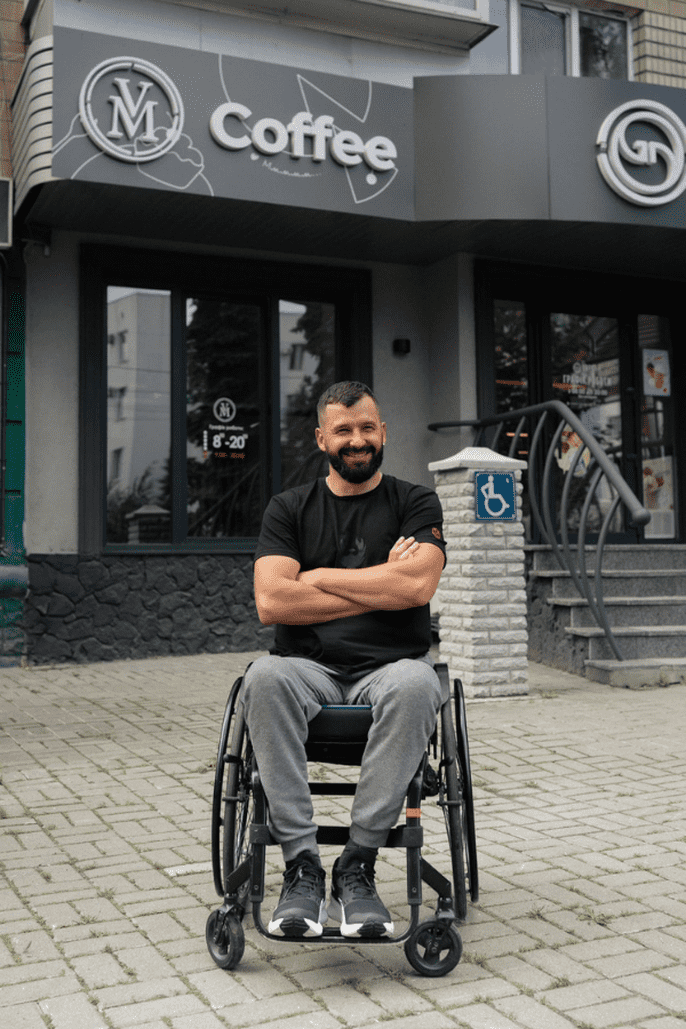
A conversation with veteran and founder of VM Coffee in Rivne, Mykhailo Nalyvaiko.
This interview is about a person who, after a severe war injury, was forced to completely change his profession and way of life. Mykhailo left his work in metal construction and, with the help of a state grant, founded VM Coffee. We talk about starting a business, adaptation, “epic fails,” and his plans to build a network of small coffee shops.
.png)
Mykhailo, how did it all begin? How did you found the coffee shop?
Before this, I had no experience in this field at all.
If I said that owning a coffee shop was my lifelong dream… unfortunately, I don’t have such a beautiful story.
When I was injured and about to be discharged from the hospital, I realized that I couldn’t return to my previous work — the trauma wouldn’t allow it. That’s when I came across the opportunity to apply for a state grant. I started thinking about how I could use it — the amounts seem decent at first glance, but when you start calculating, it’s not that big. Eventually, I came to the idea of opening a coffee shop.
And now, after opening the second one, we’re moving toward building a network of small cafés.
How much time has passed since the first one?
Since August 2025. I’m still very new to this field.
If you start asking me what coffee is and how it’s made, I can pretend to be smart, but it definitely won’t be a professional perspective.
Especially now, with all the “third-wave coffee culture” — so many nuances. I don’t have that knowledge yet.
So I thought: while baristas are learning how to work with the coffee machine and coffee in general, I’ll learn too — how to brew, how to steam milk, and soon.
And then I had this epic fail: when I ordered the furniture, I measured everything and calculated the dimensions. But when they arrived to install it, I realized I had totally miscalculated — my wheelchair doesn’t fit through the doorway to the workstation. So I thought: well, fine —if I’m the director, then I’ll stay the director. 😊
What did you do before the injury?
Before the war, I worked with metal construction — sliding gates, carports, everything related to metal. I had between 7 and 15 employees, depending on the season, sometimes working with subcontractors.
Where are you from? Where did you live, and where do you live now?
I’m from the Rivne region, but studied in Kharkiv and lived there for some time after university. Then I moved back to Rivne, and that’s when my friend and I started our metal construction business.
What does the name VM Coffee mean?
It’s the first letters of my name and my friend’s name — we’re doing this together. We actually drew the logo on a piece of paper while sitting in the car.
What’s your favourite coffee drink?
I wouldn’t say I have one favourite.
If I want to really taste coffee, I drink espresso. Otherwise, I can have a cappuccino.
Some clients come once or twice a day strictly for espresso — no deviation. I don’t have that kind of fixed choice.
Did coffee and creating your own space help with adaptation?
Adaptation was a difficult period.
It all depends on the person — how they set their mind and what they want from life. Everyone is different.
Some people need to keep moving and feel fulfilled; others are more closed. The only problem is when the war or the injury breaks a person, then it’s much harder. Why do I say harder? Because I had a moment when fighting on the frontline didn’t break me, but the severe injury almost did.
Since I can’t sit still — I get bored — that helped me a lot. I’m constantly traveling and moving.
Right now, I also work in Bukovel as an inclusivity coordinator. I never imagined I would work in the mountains. I love mountains —they’re something incredible for me. If I had to choose between the sea and the mountains, I’d choose the mountains.
.png)
Is it difficult to run a coffee shop? It’s a completely new field for you.
No, I wouldn’t say it’s difficult — I’ve always been interested in this. Even in school and university, I knew I wanted to work for myself. I can’t have someone telling me what to do.
After university, I worked in Kharkiv, and it was hard for me to work for someone else. Then I went abroad to work a few times, and afterward decided to work independently — and I got fully into it.
I thought running a café would be harder because it’s completely different from my previous work. But in reality, there’s nothing too difficult about it. The only nuance is working on the image and building a customer base.
The café is in the city center, but in a spot that’s not on the main pedestrian route.
The good thing is that clients who come leave positive feedback and start coming regularly.
Some of our regulars live outside the center — in Yuvileine or Pivnichnyi (not central areas in Rivne) — and when they're in the center, they make sure to stop by.
But they’re regular but not frequent clients.
So for now, we’re still operating at a loss. I knew from the beginning that there would be a period like this.
Some cafés open and immediately work in the plus —and that’s great. But finding such a location is nearly impossible now, or it’s extremely expensive.
Coffee competition in the city is high, not necessarily in taste, but in the number of coffee shops.
Next time I’m in Rivne, I’ll definitely stop by for coffee 😊
I’ll be waiting for you.
I’ll treat you to coffee — and you’ll tell me what you think.
I accept only honest feedback.
If it’s criticism, then it’s criticism. If it’s good, then good.
Some people come and don’t like something, but are afraid to say it.
When my friends come, I tell them: “Okay, tell me honestly — what do you like, what don’t you like?”
They start talking, and based on that, we make changes.
Link to Mykhailo’s page:
https://www.instagram.com/otaman_90/
Link to the coffee shop:
https://www.instagram.com/vm.coffee.rivne/
Gallery
No items found.